
September 23, 2026
By: Stevie Glaberson, Taman Mohamed, Kristen Weber, & Shereen A. White
Introduction
On June 4, 2026, the National Center for Youth Law, Children’s Rights, and The Privacy Center brought together nearly 100 participants, including lived experts, child welfare advocates and lawyers, data scientists, and algorithmic tool developers to discuss some of the most pressing questions facing the child welfare system today: How are we seeing data and automation shape child welfare practice today? How can we keep children and families at the center of conversations and decision about tech in this system? What might be coming down the pike? Are there any safe or appropriate uses of algorithmic tools in public sector child welfare decision-making? What harms must we guard against? Who will be accountable when automated tools cause harm?
These questions are particularly urgent in a moment of both extraordinary enthusiasm for and growing scrutiny of massive data technologies, like those marketed as “artificial intelligence.” As Stevie Glaberson, Privacy Center Director of Research & Advocacy, underscored in her keynote address on June 4, “Powerful interests have been pressing all of us to adopt technologies billed as new and innovative in virtually every sphere of our lives. We are in a moment of extreme hype, and also fervent critique.” Child welfare is no exception. The federal Administration for Children and Families has actively encouraged this trend, issuing guidance promoting the integration of predictive risk modeling into child welfare practice and announcing $6 million in funding for ten jurisdictions to pilot these tools. Right now in some jurisdictions, blocks of code determine which families get screened in for a CPS investigation, which face separation, which children will or will not be reunified with their parents, and what services may be offered to families. Some of the gravest decisions a state can make about a family are increasingly being handed off to, or influenced by, poorly understood tools. This federal promotion and investment, coupled with agency use of and potential use of technology, made the questions at the center of the convening particularly urgent.
After the event, the organizers came together to process the learnings from the day. What follows captures our collaborative summary of key conversations, questions, and perspectives shared during the convening, and identifies areas for further research and continued dialogue.
Grounding the Conversation: Data and Automation in Child Welfare Practice
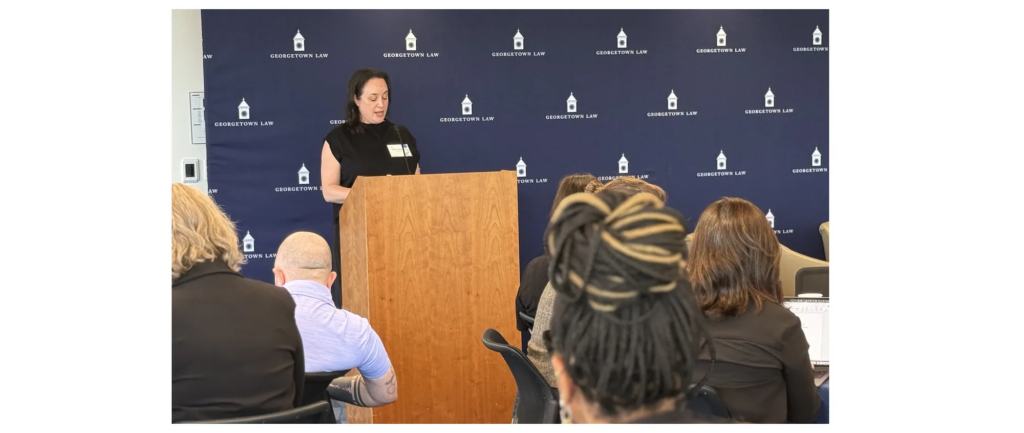
The convening began with a keynote address from the Privacy Center’s Stevie Glaberson providing critical historical context on both “emerging technologies” and the “child welfare system” for the diverse array of participants in the room. Glaberson prompted the room with questions that anyone can and should ask about the technologies being marketed to or adopted by child welfare systems — questions aimed at illuminating the purpose of the technology, how technology use might help or hurt children and families, and how we can hold those wielding and building technologies accountable to our communities.
Learning Together
Following this grounding, participants heard from a panel examining how child welfare agencies have used technologies to predict risk. Over lunch, attendees heard a talk on Digital Fundamentals and the “Tech Stack,” providing additional grounding in how these technologies work in practice. The afternoon then turned to a series of reflections on new and future uses of emerging technologies, followed by small and large group conversations about the questions, concerns, and possibilities raised throughout the day. Below are highlights from those sessions.
“Predicting Risk”
The first panel of the day delved into predictive risk modeling (“PRM”) or algorithmic decision support. These tools generally work by extrapolating rules from massive sets of administrative data (data the government has collected and holds for other operational reasons). These data sets might include demographic information like zip code, age, number of individuals in a family, and race or ethnicity, and they might include data reflecting past system touchpoints: things like prior child welfare involvement, criminal legal system involvement, and medical and behavioral health data. The best known of these, Allegheny County, Pennsylvania’s Family Screening Tool (“AFST”), is used at “triage,” when a call center worker has to make a decision about whether to send a report to the local office for investigation, and produces for the worker a “risk score.”
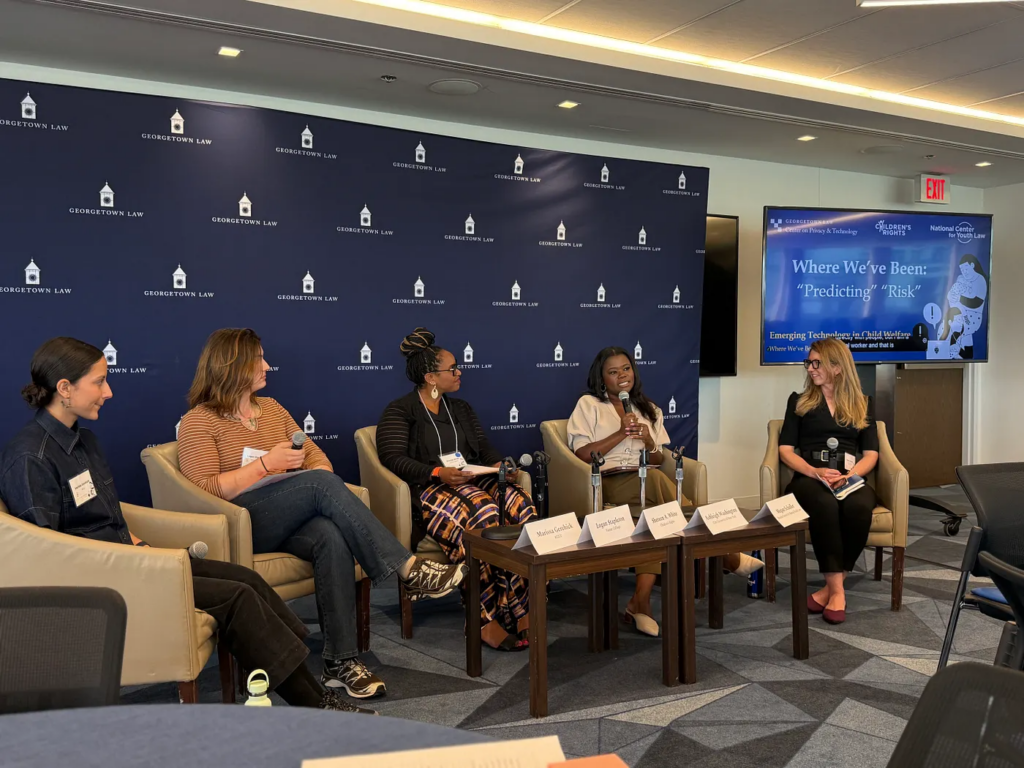
The panelists — Megan Schuller, Legal Director, Bazelon Center for Mental Health Law; Logan Stapleton, Assistant Professor of Computer Science, Vassar College; Ashleigh Washington, Public Scholar and Social Policy Researcher, City University of New York; and Marissa Gerchick, Data Science Manager, Algorithmic Justice Specialist, ACLU — each brought with them familiarity with or experience examining one system’s use of such algorithmically-driven tools.¹ Schuller, Stapleton, and Gerchick each had investigated the AFST, and Washington had completed her dissertation looking at New York City’s use of such systems, including the ways parents impacted by algorithmically-driven investigations understand and think about the tools and their effects. Where Allegheny County uses its tool at the triage stage, Washington explained that New York City uses a similar tool to make decisions about preventive services and whether and when to close services cases. One panelist also brought up Allegheny County’s newer tool, “Hello Baby.” Hello Baby is a nominally voluntary program (although, as the panelist pointed out, the program does not run on an opt-in basis, but instead parents must affirmatively opt out while in the hospital in the throes of childbirth and the immediate postpartum period: “if you don’t opt out, the algorithm is run against you”). The county then retains and uses the algorithmic output to make decisions about what services to offer to a family. The panelist stated that the tool’s accuracy had been measured at a mere 20%.²
The panelists defined these tools generally as using patterns (correlations) in data to quantify the risk of certain outcomes about families. Echoing the morning’s keynote, panelists discussed the importance of clarity around the specific outcome being predicted. The AFST, for example, does not predict whether harm will occur in the home, but rather the likelihood that a family will be re-screened, or that a child will be separated, within two years. As one panelist put it, the question the AFST really assesses can be understood as: Does this family look like a family we have torn apart in the past?
The panel discussion raised important questions about the data that goes into these models, and the value-laden human decisions required to build them. For example, where a model includes juvenile legal involvement as a variable, there must be a human process to determine whether such a variable acts as a binary (i.e. presence=1; absence=0), or in a nuanced manner.
Panelists also questioned some of the underlying assumptions behind these tools. For example, they discussed how the idea behind the AFST was for workers to be able to make needed decisions informed by as much data as possible. But they questioned whether that assumption is borne out by reality. As one panelist put it, “more is not always more.” When researchers removed certain problematic data factors, the outcome remained the same.³ At the same time, panelists noted that the inclusion of data that revealed individuals’ disability status resulted in individuals perceived as disabled having a score that was four points higher merely due to their disability. Therefore, the panel concluded that the decision whether to include any specific data point is a policy decision with potentially severe consequences.
The panel also discussed the workforce impacts of the use of these tools. As part of their research, Stapleton embedded with hotline workers and interviewed them about their experiences with the implementation of the AFST. Workers in the study professed feeling that the imposition of the tool, rather than being about child safety or more accurate decisions in individual cases, was instead agency executives’ way of more directly influencing the decisions workers would make. They described feeling pressured to use and rely on the algorithm more. And workers explained that they knew the tools were relying on biased data and that the results would therefore be biased.⁴
Finally, the panel discussed the importance of centering the voices, perspectives, and needs of impacted families in all these conversations and decisions. Washington reported finding in her research that, while families may not know that they have been scored by an algorithm, they knew they were being labeled by system actors as “high risk.”
Digital Fundamentals and the “Tech Stack”
The convening next turned to the digital fundamentals underlying emerging technologies. Emily Tavoulareas joined participants to provide a practical understanding of how digital products are developed and put into practice in government, and to introduce the “tech stack” — the layers of infrastructure, databases, architecture, and interfaces that make up the technological tools with which we interact (which Tavoulareas likened to a “stack of pancakes”).

Tavoulareas was a founding member of the United States Digital Service’s (“USDS”) first agency-level team. USDS was an Obama-era initiative housed within the Executive Office of the President, the goal of which was to bring mission-driven private sector professionals into government for term-limited tours of civic service, to work alongside agencies to deliver faster, simpler, more reliable experiences. They said they worked on “solving the government’s most urgent problems” like veteran service delivery, Medicaid and Medicare, and modernizing the affirmative immigration application process. It was an important and exciting initiative. It was also the site within the Executive Branch that the Trump Administration colonized to create DOGE.
This talk aimed to equip attendees with answers to questions such as when and where are the human decisions forming these products made, and by who? If I want to intervene in a process going on in my home town, when can I do so, who can I talk to, and how can I speak in their vocabulary so I have the best chance of being heard?
Tavoulareas explained that digital technology (any software-enabled thing that provides utility to humans) is increasingly the touchpoint through which people engage with products or services, including government services. She demonstrated how digital technologies are made up of different layers, “like a stack of pancakes.” There are the layers that you see–the front end interfaces and systems–and the layers that you don’t, like the back-end databases, cloud infrastructure, or legacy technologies. The deeper down the “stack” a particular element of the system is, the harder it is to change or replace. She warned attendees that the promise of technologies most often breaks down in the implementation, and she provided a primer in how digital technologies are–or should be–built.
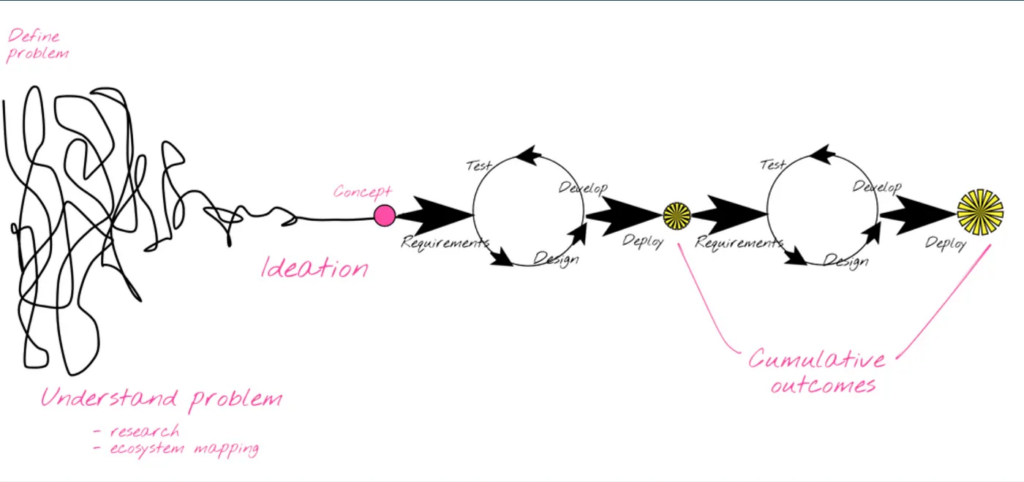
Echoing themes raised throughout the convening, Tavoulareas emphasized that, ideally, government agencies and developers will first work to deeply understand the problem they are trying to solve, before moving forward to creating hypotheses and concepts for how a particular digital product is well-suited to solving that well-defined problem. Only then will they move forward to creating a product, designing and developing it in iterative processes through which the product design may change and improve to better tailor to the defined problem. What too often happens in reality, however, is that groups assume they have a complete picture of the problem, write it down in RFPs, contracts, and even legislation and regulation, and then move forward to rigidly design a tool to meet those specifications, while the real problem remains buried (until it is discovered multiple years and millions of dollars later, when the designed solution fails). In addition to failing to adequately define the problem being addressed, Emily noted that things go wrong when agencies work in rigid top-down workflows that prioritize the solution (the technology) over what the group is trying to accomplish (the service); when they lack capacity to manage systems themselves, resulting in dependence on external entities like contractors; and when they value efficiency over effectiveness. To improve a system, she cautioned, don’t look to see where tech can fit in. Rather, see the problems in the system and work to solve those problems, then see where the tech may fit in. She challenged attendees to ask themselves key questions whenever contemplating a design process:
- What problem are we trying to solve?
- Who knows the system best?
New and Future Use of Technology in Child Welfare
A diverse group of thinkers took the stage to engage in brief individual lightning talks about their research and current experiences with tech being marketed and discussed as “artificial intelligence,” before conversing together in a fishbowl conversation. This group included Devansh Saxena, Assistant Professor, University of Wisconsin, Madison; Mollie Warren, Family & Children’s Services Director, and Clement Bayetti, Data and Performance Manager, both from Boulder County Human Services; Rua M. Williams, Assistant Professor, Purdue University; Shion Guha, Assistant Professor, University of Toronto, and Altaf Kassam, Director, Child Welfare Institute, Children’s Aid Society of Toronto.
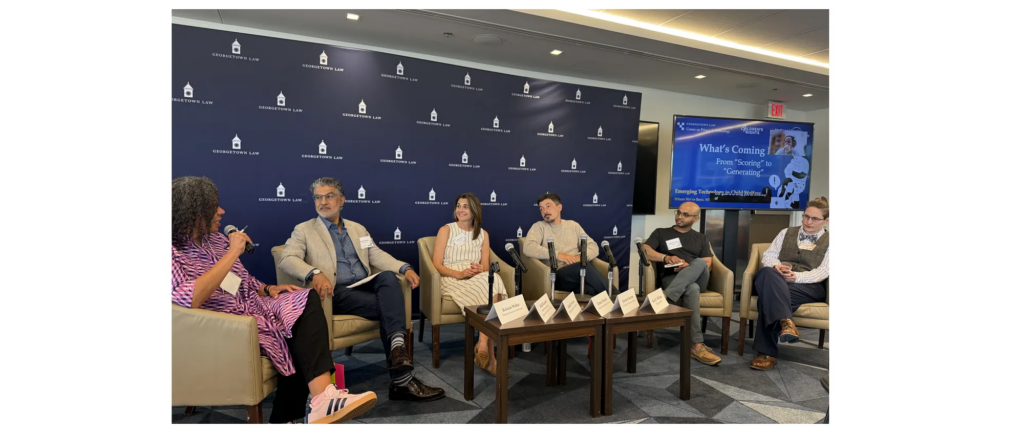
The first reflection was from inside the system–Mollie Warren and Clement Bayetti described emerging technologies being marketed to them with little help or guidance about their validity, how they should be used, and why they may be of value. They described some pressure to adopt tools coming from their own workforce’s interest in and, absent guidelines, use of publicly-available tools (“we didn’t do AI, AI happened to us”). They identified a desire for rigorous and honest conversations with other child welfare leaders, communities, and technologists about the potential real-world value of these tools, behind and beyond the hype. They also explained that for an organization to truly become “data-driven” requires substantial investment and people power. Of perhaps greatest interest to attendees, however, was the team’s sharing of how under their leadership their county had, in just 3.5 years, reduced the number of children involved in the system by more than half, and the number of children in placement by nearly 50%. They did so, they reported, not by adopting technologies or increasing efficiency, but by “building risk tolerance as a muscle” and really confronting the “harm we create by removal.”
Next Altaf Kassam and Shion Guha reflected on their effort to design and use human-centered large language models (“LLM”) to identify and interrupt patterns resulting in families having lengthy involvement with their agency. They focused on families for whom engagement with the agency lasted for over one year, and sought to explore how technology could help them to answer the question: “How do we better understand our own service processes, support workers, and reduce unnecessary system involvement for families?” Echoing the discussion of ensuring that any work with technology be grounded in a well-defined real-world problem, they emphasized the importance in their collaboration of starting “from a child welfare [a]gency-defined problem that is being studied carefully [and] thoughtfully.” To do so, they investigated whether they could use an LLM to process case worker notes to identify patterns that resulted in cases staying open longer.⁵ Through interviews, focus groups, design workshops, and careful prototyping, the team worked to conduct a retrospective analysis of why cases stay open longer. They found that their LLM was able to surface broad patterns across case documentation but that the tool performed worse when relevance depended on changing family circumstances, evolving service goals, and professional judgment. They concluded that LLMs may support agency learning and reflection but “cannot replace social work judgement.”
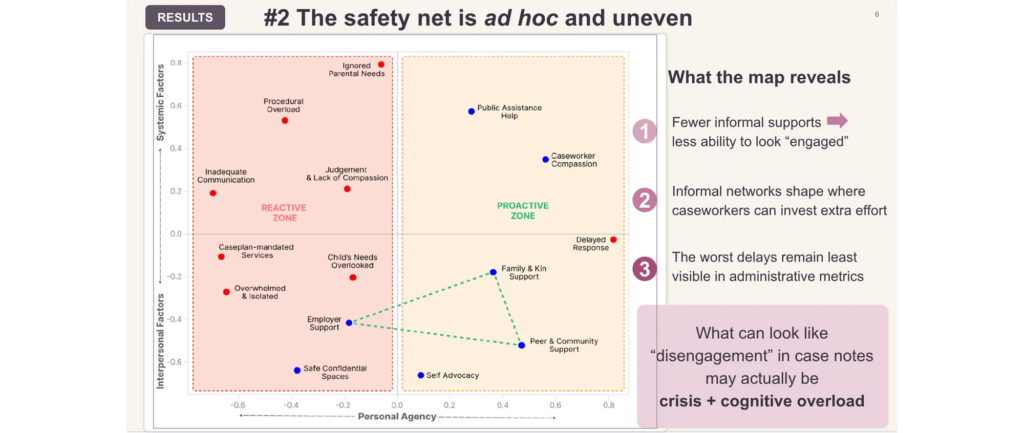
Researcher Devansh Saxena reflected on one effort to use computerized tools to “study up,” or assess the work of the system (rather than training these models on families). Professor Saxena’s presentation focused on a study he conducted with colleagues to investigate how “public safety net infrastructures record, interpret, and respond to the lived experiences of the people they are meant to serve,” specifically showing how child welfare “metrics that treat ‘support’ as units of service can mislead when they ignore the ad hoc safety net parents rely on, how informal networks condition whether formal services function as support at all, and how parents’ perspectives can inform the design of collaborative information systems” more directly keyed to real-world needs of families. Instead of using algorithmic modeling to make predictions about individual families or to draft or summarize case notes, Professor Saxena’s project looked to use language models to interrogate the child welfare agency’s own data. The team found that measures that systems rely on to prove that they are providing support (referrals made, services completed, cases closed) map poorly to families’ needs and lived experiences of true support. Agency practices that may “look like support on paper” may feel like neglect, accusation, and overwhelm on the ground. Conversely, Saxena’s work revealed that families with existing informal support networks tended to receive more proactive and positive support from case workers, while caseworkers tended to be more likely to ignore the needs of families with fewer existing resources, or approach them with increased judgment and lack of compassion.⁶
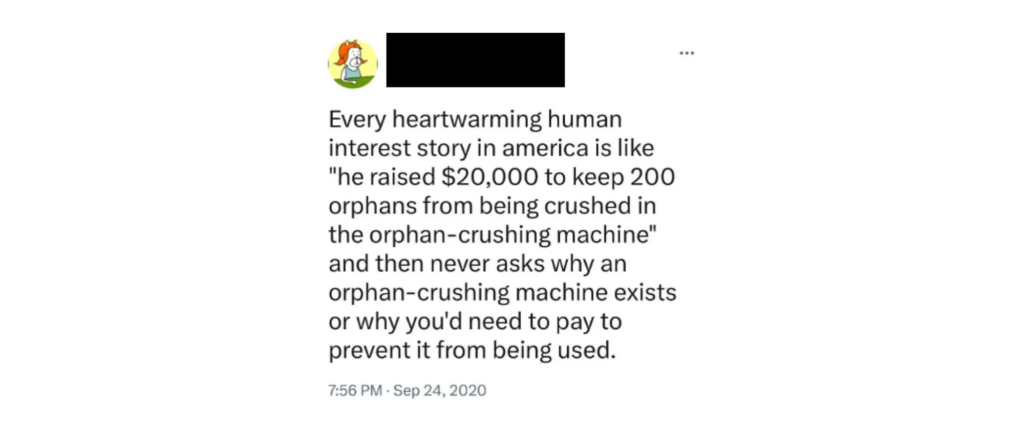
Rua Williams used their time to tell the stories of four families–all families with disabled members, all with queer parents, and all with varying experiences with the system. These stories highlighted the ways in which vulnerable families have no way out of participating in the generation of the very data that will be used to rank and score them: for one mother, “to refuse” undesired services “was to surrender her children to the state,” for another, a “‘history’ is forever, and ever growing.” “The system already works on logic cascades,” Williams said: “A queer parent is suspicious, a mentally ill parent is a risk, a disabled parent is unfit, a poor black parent is a risk, a felon doesn’t have the right to their baby, and once any of these lines is crossed, the system keeps questioning, keeps doubting, keeps evaluating, keeps denying, keeps sending you more. fucking. forms.” In closing, Williams told attendees: “If you want a better present and future for our children it will not come from the echoes of a data center. It will come from you and your refusal to let this machine crush any more” families.
Looking Forward
The day ended with attendees engaging together to reflect on learnings and generate open questions. Based on the research and information presented throughout the day, participants explored the following questions in small groups:
- What should the guidance be for systems using emerging technologies that impact children, parents, and families involved with child welfare?
- What guardrails must be in place to ensure families are centered and protected?
- What uses of tech or data should be off limits? Why?
- What open questions require further research and/or conversation?
Participants used these questions as grounding to work together in facilitated small-group discussions to reflect on the earlier presentations. Not every table discussed every question. At the conclusion of the exercise, participants recorded their ideas on sticky notes and posted them around the room to be viewed by all. The day concluded with a whole-room discussion about some of the most pressing issues that emerged at the tables. Below is a high-level summary of what the group generated.
Guidance & Guardrails
The day was not set up to ensure that attendees reached any kind of universal consensus, but a few themes emerged in attendees’ suggestions for the guidance that should be given to agencies considering adopting technologies and the guardrails that should be in place before any such technologies are deployed. Participants emphasized:
- Community control: Attendees suggested that systems might employ a “Community Advisory group” and that families must play a role in shaping any system uses of technology. As one attendee noted: “Let’s not design how to use AI — let’s ask impacted communities how AI can make their lives better.”
- Transparency: Participants stated that families should know what technologies are being used and how. Some identified informed consent as an important guardrail (e.g., “Informed disclosure of how technology and data are being used with transparency”; “Require [family] consent/Knowledge of data utilization”). In the context of individual cases, participants also raised the importance of parents and their attorneys knowing when predictive analytics has been used and having the opportunity to scrutinize and challenge the technology in court, including through examination of those responsible for developing a model.
- Standards, testing, and ongoing review: Participants raised a range of ideas in this category, including the development of a code of ethics for the use of AI in child welfare, guardrails around caseworker chatbot and transcription use, regulatory standards, third-party audits, and testing prior to deployment. Participants also suggested that known risks and failure rates should factor into decisions about whether to deploy a tool, and that technologies should be closely monitored and their effects regularly reviewed after implementation.
- “Studying up”: Several participants emphasized that technological tools should primarily be used to look at how the system functions (rather than being trained on individuals or families). Some suggested tools could look “both ways” (at families and at system performance), while others noted that these tools should only be used to assess system actors and system functioning.
- Limiting potential harms to children and families over time: Among the ideas raised were ensuring that children’s “scores” do not follow them into adulthood. Some participants noted that “AI” tools may not necessarily increase efficiency of the child welfare workforce, nor is efficiency necessarily a proper focus. Others emphasized that these tools do not necessarily decrease worker bias nor the carceral nature of the child welfare system’s interventions.
Off-Limits Uses
A central theme in attendees’ thoughts about what uses of technology should be off limits was the idea that algorithmic technologies should not be used in decisions about individual children and their families, especially decisions that could result in family separation (e.g., “NEVER in removal decisions”; “The decision to remove a child from the home should never be made by an algorithm”; no “irrevocable decisions”; no “individual scoring”). While a few participants suggested banning “AI” decisionmaking altogether, others were more specific about the circumstances under which “AI” should be off-limits.
Other participant ideas as to what should be placed off limits included:
- Don’t sell data — meet privacy and security (high) standards
- Ban 100% AI Decision Making
- No Tech not overseen by humans
- Mental health data should be off limits
- Interagency data sharing
- Unlimited data retention
- Hiding the use of AI from families
- AI may be inevitable, BUT predictive risk assessment tools or any AI used in decision-making for child welfare is NOT and should not be
- At minimum, look to EU AI Laws + other international regs on what is an unacceptable level of risk
Further Research and Conversation
Participants were eager to continue learning about technologies in child welfare, interrogating how they may be used to help improve outcomes for children and families and how they might be harmful, and to involve more people in rigorous inquiry.
Participants raised a desire to have further conversation like those had in the room among their peers. Three examples include: 1) supporting child welfare agency leaders in understanding what technologies are being sold to them and what questions they should be asking; 2) family defense legal advocates learning from disability advocates and public benefits advocates about how they have pushed back against broad and discriminatory uses of similar technologies; and 3) supporting those with lived experience or who are currently involved in the system in gaining tech literacy, sharing their own perspectives and experiences, and advocating for the kinds of futures they want to see.
Participant suggestions for future interdisciplinary conversations included:
- How can tech be used to empower communities?
- Let’s talk about how to use AI to abolish CPS/Family Policing/end the need to separate families-not how to do harm more efficiently please
- What happens when automation starts to creep back to mandatory reporting? How do we make sure these conversations inform that potential
- How do we use data and tech to “watch up”?
- Who/How do we serve youth aging out?
- Are worries dismissed to get out of the way and bulldoze into reckless innovation and excitement?
- What countries or jurisdictions have good regulations/approaches? How can we emulate them?
Suggestions for further research include:
- Evidence of tools’ effectiveness, impact, improvement, and beneficial value
- How do we test deployment? Why are data sets from testing so different from the real world?
- How do we do research that can enable civil rights challenges of AI systems?
- Can we track how emerging technology / AI will change child welfare Culture (Belief/Practice)
- To what extent are communities being included in conversations about AI/tech integration?
- What would citizen-led AI use look like? What would they do to protect themselves?
- Impact on intersectional marginalized communities
- Can we put better information into AI models + then get better information out?
Finally, participants reflected on the lack of governmental leadership to protect the public and that this void “is dangerous and leading to AI for profit”. Many participants wanted to know how we hold the government accountable to protecting the public good.
The day ended with a happy hour sponsored by Think of Us. Attendees continued their discussions, met and engaged with folks they had never met or engaged with before, and continued the learning and questioning begun earlier in the day. Long after the food and drink were gone, attendees remained in the space, sharing together.
Aftereffects
In the weeks that followed the event, we heard from attendees and those that were not able to be there through informal communications and a post-event survey. Attendees shared insights about what worked, for example:
What stood out most was the willingness of participants to engage with the “good, bad, and ugly” of AI rather than settling into easy answers. The discussion encouraged critical thinking about who designs these systems, whose values are embedded within them, who benefits, and who may be harmed.
As AI continues to shape public systems, conversations like this feel essential. They help ensure that technology is not discussed in isolation from questions of equity, power, accountability, and human relationships. Thank you for creating a space where people could learn together, wrestle with difficult questions, and remain curious about both the promises and pitfalls of this emerging technology.
I’ve been looking for a “way in” to thinking about AI in the public sector that wasn’t product focused or evangelical. Bringing together child welfare professionals, lawyers, and quants was exactly what I needed.
And about some things they were left sitting with. For example:
I am sitting with the question of how can we move the “AI in child welfare” space beyond a conversation on predictive analytics and risk modeling to a deeper exploration, discussion, and evaluation of generative AI and LLMs. I felt that the conversation at the event was largely focused on the harms, risks, and critiques of technology use in child welfare, but I think this was primarily concentrated on the use of predictive algorithms, and there is more to explore beyond that topic.
[The conversation about Hello Baby] raises questions for me about whether it’s even possible for government-provided programs to be a force for good. I think all of us want to believe that government can be a force for good — we certainly want kids going to high-quality schools, and high-quality child care, and high-quality health care. But there’s something about the in-between services — services that we want to provide on a voluntary basis to families to ensure they don’t have to experience the child welfare system — where I hear a lot of confusing messaging about whether we (public services) can truly help or are doomed to always effectuate harm.
Conclusion
The event on June 4 was just a beginning. More conversations like these need to happen in rooms across the country, creating space for everyone to learn and engage together about what these technologies are, what they are not, and how we might intervene to ensure that our collective future is one we want to inhabit together. We look forward to continuing the conversation with you!
Endnotes
- See, e.g., Marissa Gerchick et al., “The Devil is in the Details: Interrogating Values Embedded in the Allegheny Family Screening Tool,” FAccT ’23: Proceedings of the 2023 ACM Conference on Fairness, Accountability, and Transparency 1292 (2023) https://dl.acm.org/doi/10.1145/3593013.3594081; Hao-Fei Cheng, Logan Stapleton, Anna Kawakami, Venkatesh Sivaraman, Yanghuidi Cheng, Diana Qing, Adam Perer, Kenneth Holstein, Zhiwei Steven Wu, and Haiyi Zhu, How Child Welfare Workers Reduce Racial Disparities in Algorithmic Decisions (2022); Ashleigh Washington, Calculated Risks: The Power of Predictive Risk Models to Regulate Families of Color (2026); Ashleigh Washington, Biomedical Surveillance in the Child Welfare System (2025); Sally Ho and Garance Burke, Here’s how an AI tool may flag parents with disabilities, AP (March 15, 2023), https://apnews.com/article/child-protective-services-algorithms-artificial-intelligence-disability-02469a9ad3ed3e9a31ddae68838bc76e.
- As discussed in the room on June 4, how one measures the “accuracy” of a tool like this is itself a value-laden and political question. Tool designers rely on several different measures. One such measure is “area under the curve” (AUC), which has been criticized, including by presenters at the event. See Kweku Kwegyir-Aggrey et al., “The Misuse of AUC: What High Impact Risk Assessment Gets Wrong,” FAccT ’23: Proceedings of the 2023 ACM Conference on Fairness, Accountability, and Transparency 1570 (2023) https://doi.org/10.1145/3593013.3594100. Another measure is “precision,” or how often the model’s prediction proves correct. The designers of Hello Baby have stated that their tool has a precision of 20%: one in four newborns classified as highest risk by the model would have experienced a home removal. See Allegheny Ct’y Dep’t of Human Servs., Hello Baby FAQ, https://analytics.alleghenycounty.us/wp-content/uploads/2020/11/HB_FAQ-updated-11-5-2020.pdf.
- See Gerchick et al., “The Devil is in the Details: Interrogating Values Embedded in the Allegheny Family Screening Tool,” at 1298 (2023). One explanation for this is the problem of “omitted variable bias”: when an important, influential variable (like race or socioeconomic status) is omitted during model training. Other, correlated variables sometimes will take on the weight of the omitted variable, becoming a sort of “algorithmic Trojan Horse” for the omitted variable. Stephanie K. Glaberson, Coding Over the Cracks: Predictive Analytics and Child Protection, 46 Fordham Urb. L.J. 307 (2019).
- In How Child Welfare Workers Reduce Racial Disparities in Algorithmic Decisions, Stapleton’s team found that the AFST, operating alone, would make more racially disparate decisions than workers making decisions alone before its introduction. But when the workers made decisions with the tool, they were able to correct and reduce disparities. One explanation for this finding is that the workers, because of their understanding of how the tool worked and the disparities in the underlying data, were able to see the tool for what it was — a statistical aggregate of the system’s own past behavior — and use its so-called “prediction” not as a crystal ball, but as a mirror, forcing them to confront and reflect on the injustices the system is inclined to perpetrate.
- In their research study, Kassam and Guha compared the LLM’s judgments about whether a case note reflected progress on a family’s service plan goals against those of a human reviewer. The two matched closely on shorter cases but the tool worked less reliably as cases became more complex. The researchers attributed this partly to technical limitations, but also to the fact that judging whether a case note reflects real progress requires the kind of discretionary judgment that comes from social work training and experience. See Erina Seh-Young Moon et al., The Promises and Perils of using LLMs for Effective Public Services, Proceedings of the 2026 CHI Conference on Human Factors in Computing Systems (2026), doi.org/10.1145/3772318.3790297.
- Devansh Saxena, Melissa Radey, and Lenore Mcwey, When Metrics Mislead: Parents’ Lived Realities in the Public Safety Net, In Proceedingsof the 2026 CHI Conference on Human Factors in Computing Systems (CHI’26), April 13–17, 2026, Barcelona, Spain. https://dl.acm.org/doi/epdf/10.1145/3772318.3791862