
July 23, 2026

On June 4, 2026, the Center on Privacy & Technology at Georgetown Law, together with co-organizers Children’s Rights and the National Center for Youth Law, convened a day-long event at Georgetown on the growing role of technology in child welfare practice. The event brought together leaders from across disciplines and lived experiences to talk about the ways government agencies charged with the protection of children are adopting data products, automation, and surveillance technologies. Researchers, advocates, technologists, practitioners, agency leaders, individuals with lived expertise, and policymakers came together to learn from each other, to identify pathways for research, advocacy, and policy, and to ensure that the needs of children, youth, and their families remain the center of focus. Privacy Center Director of Research & Advocacy Stevie Glaberson gave the day’s keynote address. A lightly edited excerpt of her remarks is below:
Powerful interests have been pressing all of us to adopt technologies billed as new and innovative in virtually every sphere of our lives. We are in a moment of extreme hype, and also fervent critique. Even the Pope has weighed in, dedicating his first encyclical to the problem of ”Safeguarding the Human Person in the Time of Artificial Intelligence.”
Though child welfare as a field is often seen as woefully analog and behind the digitalized times, it is not immune. We have already seen agencies incorporate and experiment with a variety of digital-era technologies like predictive risk modeling — which I will explain in a bit more depth in a moment.

The federal government is now putting funds behind a push to expand States’ use of technology, including “predictive analytics and tools powered by artificial intelligence” in their child welfare systems, even as that same administration slashes supportive funding and regulation. We’re being told that “the time is now” to use computerized risk prediction to rank and score our families. And a generation of families and workers is coming up and through school in a world in which they are being told it may be possible to outsource everything from mundane administration to creative expression and critical analysis to a machine.
The kind of technological change currently being foisted upon us is often billed as inevitable, our role merely to acclimate to it. Many have written about how that inevitability narrative is intentional — meant to disempower us and transform us into willing participants. But we brought you all here today because nothing is inevitable. We can and must fight together for the future we want to see.
We need everyone to be a part of the conversation, and we need a conversation that asks fundamental questions: Does the adoption of a particular technology or tool align with our values? Does it promote human flourishing? If not, what should we do about it?
So we are here specifically to talk about “emerging technologies in child welfare.” There are two big pieces to that phrase: “emerging technologies” and “child welfare.” Some of you are experts in one, and may know little or nothing about the other. Some are early tech adopters, some are self proclaimed AI haters, many lie somewhere in between. All come from different standpoints.
That diversity of experience and viewpoint is intentional. The June 4 event was intentionally multi- or, rather, “transdisciplinary.” We wanted the day (and all the conversations that will come after) to include a wide range of perspectives — but to be centered in a shared willingness to learn and to struggle and to take on big challenges in order to support kids and families.

To ground this conversation, the following attempts to give each person enough scaffolding so that we can move forward together, with a shared vocabulary and sense of purpose.
First: The Child Welfare System
When we refer to the “child welfare system,” we are referring to the agencies and workers that have been tasked by federal and state law to respond to and investigate reports of abuse and neglect of children in their homes.
As many before me have noted, the logics and structures of today’s modern system can be traced back through history — through the War on Drugs, the Indian Boarding School era, through the Progressive Era and the moral construction of poverty, back to slavery and white landowners’ control over the reproduction of black women and their separation of parents from their children through sale and violence.
There is a maxim in the world of systems thinking that I think is helpful in thinking about the child welfare system: POSIWID — “the purpose of a system is what it does.” What it means is that we don’t have to get bogged down in questions of intention or design, in who’s at fault or why we’ve landed where we are, we can look at the effects of a system to evaluate whether it is a success.
Employing POSIWID here, and without delving into questions of design or intention, we can say that the child welfare system allows the state to gain visibility into the homes of more than one-third of American children during their childhood, and more than half of Black children. It gathers information and passes judgments on whether those families are suitable for the children in them. It almost exclusively investigates poor families. It sometimes offers resources and services when they are available (which they largely are not). It often mandates services — things like drug testing, mental health evaluations, and parenting classes, that bear little relation to the reason the system was activated in the first place, causing strain and sometimes even job loss and homelessness. It spends more on investigating, removing, and placing children in strangers’ homes than it does on supporting them in their own. It separates families, again at disproportionate rates on the basis of race, disability, and socioeconomic status. And it doesn’t reliably make children safer.
So that’s the system we’re talking about layering tech onto. Clearly there are problems. The question is: how should we think about whether and where tech may be capable of offering solutions — and where it risks entrenching existing problems or creating new ones?
Next: The tech
So let’s turn to the tech. We set up the June 4 event to focus on two big and somewhat amorphous categories: risk prediction algorithms, and other technological tools marketed as “AI.” Let me try to give some content to those opaque words.
First, it is important to recognize that the technologies we are confronting today did not emerge out of nowhere. Like the child welfare system, they have deep and racialized roots in our past. One can trace the logics of today’s technologies directly back to slavery and colonialism. Many of the habits and practices we take for granted today — the reduction of our every move to numerical data that is then categorizable, sortable, and parsable by computers — are the modern descendants of practices of reducing humans to their numerical values that allowed far away plantation owners to remotely monitor and control Black enslaved life in the colonies.
In the child welfare administration context, these technologies represent the latest step in a decades-long effort to make child welfare agency decision-making more standardized and efficient.
For years, child welfare agencies — like virtually every other public system — have been collecting ever-larger amounts of data and developing new ways to organize, analyze, and use it.
At the same time, there has been a parallel push to translate human judgment into structured processes that can be measured, tweaked, replicated, and, increasingly, automated.
That brings us to the topic of algorithms. At their core, that is what an algorithm is: a set of rules or instructions for reaching an outcome based on available information. You can think of it as a recipe. Given certain inputs, the recipe produces an output. Algorithms can be simple or highly complex, the inputs and rules can be human-constructed or inferred by the machine, but they all share the same basic logic: predicting an outcome given new data, based on rules dictated by their developers or drawn from past data.
One important example of this long move toward algorithm-ization is Structured Decision Making, or SDM, tools, which many agencies have already been using for years. SDM tools rely on structured questionnaires and scoring systems to guide decisions about risk, safety, services, and case outcomes. These tools are often described as “actuarial” because they rely on statistical analysis of past cases to guide future outcomes.
SDM tools were introduced in an attempt to improve consistency, transparency, and predictive accuracy compared with unstructured professional or clinical judgment. But they also raise important questions: What outcomes are being optimized? What information counts, and what gets left out? How do workers actually use these tools in practice? And what does it mean to translate decision-making into a checklist or score?
Those questions become even more important as we move to the next generation of tools and the subject of our first session of the day: risk prediction algorithms, or “predictive analytics.” Risk prediction algorithms are basically algorithms that use large collections of administrative data — often drawn not only from child welfare records, but also from public benefits systems, schools, hospitals, and the criminal legal system — to identify statistical patterns. They then use those patterns to assign probabilities to future outcomes, such as whether a child is likely to enter foster care.
We have already seen agencies from Pennsylvania to Colorado, New York to California, use tools like these in various ways — often at “triage” — when they need to make a decision about whether to screen a hotline call in for investigation. The best-known of these, the Allegheny Family Screening Tool or AFST, does just that. Other agencies use similar tools to support other decisions: where to direct resources, what services to recommend, or sometimes whether and when to return children home.
Are the tools I’ve described so far AI, you might be asking? Well, no, but I’d argue that that is actually a meaningless question. Let me explain.
Although “artificial intelligence” is the name of a subfield of computer science, “AI” has increasingly become a fairly meaningless marketing term. The hype around the idea that we are creating machines that can think for themselves is often used to make certain forms of automation sound sophisticated, powerful, or even mystical. When technologies are presented this way, intentionality and accountability become harder. The focus shifts away from the people and institutions building, deploying, purchasing, benefiting from — and being harmed by — these tools.
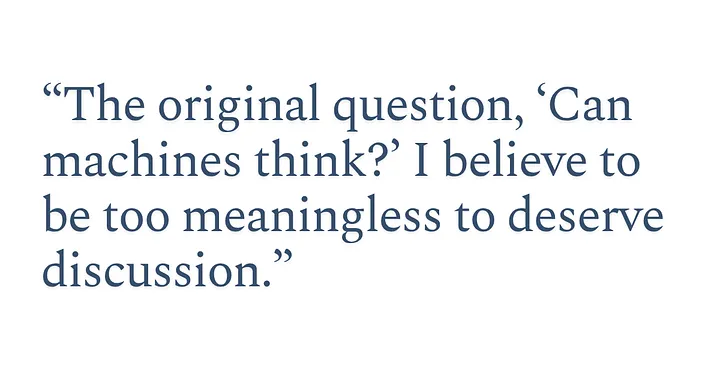
Those are fundamentally not the same question. Being capable of independent thought is not the same thing as mimicking human text output.
I like to tell people about this because it not only undermines the hype around thinking machines, but I also think it well illustrates the problem we are confronting in today’s conversations about technology: the chasms that exist between what you might hear if you listen at a surface level to what is being said, and what is true if you scratch at that surface and look at what’s really underneath.
That observation leads to two interrelated lessons that I hope you’ll carry with you:
- First: don’t get distracted by hype. The question is never whether a technology is or has achieved “artificial intelligence.” The question is what the tool being contemplated actually does and whether that function serves the humans it should.
- Second: Insist on concreteness and specificity. Whenever you hear someone discussing “AI,” ask them to be more precise:
— What exactly is the technology?
— What data does it use?
— What outcome is it designed to predict?
— Who built it?
— Who owns it?
— Who profits from it?
— Who is accountable when it causes harm?
At the Privacy Center, we often try to avoid using broad labels like “AI” or “machine learning” in our work — not because we are trying to create new taboos around language, but because we are trying to cultivate intellectual discipline. Specific descriptions help us confront what is actually happening and reveal who is pulling the levers of power.
So when we talk about the prospect of adopting “AI” in child welfare, we need to be specific about what we’re talking about. And folks are talking about it. So far, we’ve seen talk of chatbots like what you’ve probably already seen with ChatGPT and its like. We’ve seen floated the prospect of tools that designers say can process case worker notes (often referred to as “unstructured data” — reflecting the messiness of human interaction) and generate summaries or alerts, or tools that generate other forms of content.

But fundamentally each of these tools also operates through statistical correlation. Rather than predicting a child’s future risk level for a particular outcome based on large amounts of administrative data, they often predict things like the next most likely word, phrase, or sentence, based on patterns constructed from even more enormous amounts of prior data.
Overall, the underlying logic of each of these tools is remarkably similar: treating select aspects of the past as determinative of a particular future. Scholar Shoshana Zuboff has warned that data products like these can threaten “the right to a future tense” — the ability of people to define themselves by what they might become, rather than by one constructed story about what has already happened to them.
A critical question, then, is not whether these tools are accurate. (Although whenever the question of accuracy arises, we need to insist on specificity and ask: accurate by what measure?) The more important questions require grappling with when, and in what ways, we are comfortable with the past becoming cemented into prologue, and buried in code.
And that brings me to my next point: If you feel nervous about whether you’ll be able to engage in these conversations because you don’t know the tech, I want to take a moment to speak directly to you. You’re exactly who we need in this conversation. We’ve brought some of the leading computer and data scientists thinking about and studying the adoption of emerging technologies in child welfare practice together (and compiled their research here). You can gain increased tech literacy. But I want to take a page from Ruha Benjamin, a prominent thinker on race, justice, and technology, who has reminded us that we don’t just need tech literacy — “technologists need more social and emotional literacy.”
You don’t need to be a computer scientist to ask whether a system is fair. You don’t need to understand the mathematics of regression analysis to ask whether a technology helps us address the root cause of a problem, or makes doing so harder. You don’t need to know how to code to recognize when accountability is being obscured. You know yourselves and your communities. You know your clients and colleagues. Your role is not simply to learn about these technologies, although you may do some of that. It is to learn to insist on asking the questions that technical expertise alone cannot answer.
So I hope you approach discussions about tech in child welfare with curiosity — open to learning new things, but even more importantly, attentive to the moments when something doesn’t sit quite right. Pay attention to the questions that arise. Pay attention to that voice in your head that says, “Something feels off here.” Only by staying curious and following those instincts can we continue to effectively advocate for children and families.
I want all of us to ask questions like these:
First: What problem are we actually trying to solve?
Is this fundamentally a technology problem, or is it a social problem? What is the root cause of the issue we are confronting? If the answer is poverty, lack of housing, inadequate healthcare, insufficient childcare, overreporting, or underinvestment in families, is technology actually a solution?
Many of these tools cost hundreds of thousands or even millions of dollars to develop, purchase, maintain, and train people to use. Could that money be better spent addressing root causes directly?
Second: What exactly does whatever tool we’re talking about do?
Lawyers know that the question you ask determines the answer you get. The same is true for algorithms.
Remember that algorithms are designed to produce a particular outcome based on particular inputs. How they get there may be more or less under the control of their developers. But that means one of the most important decisions in building a tool is defining what outcome the system is attempting to produce.
Consider the Allegheny Family Screening Tool. It is used when hotline calls come in to child protective services and is intended to assist with screening decisions. But it does not and cannot measure the actual risk to a child in their home because that is not something that we as a society do or really could measure. Instead, it relies on proxies.
In its original form, the AFST was made up of two interrelated models aimed at two different proxies:
- the likelihood that a child whose case was screened out would be referred to the agency again within two years.
- the likelihood that a child whose case was screened in would be removed from home within two years.
Notice how different those questions are from the question decision-makers actually need answered in that moment: Is this child at imminent risk of serious harm in their home today?
One way to think about it is that the tool is not really predicting the risk posed by caregivers. It may instead be predicting the risk posed by the system itself. Things like:
- How likely is this family to remain under surveillance, given our social structures?
- How likely is someone to report them again?
- How likely is it, as a historical matter, that the system itself would separate this family?
Third: What data is required, and what risks come with collecting it?
Data is not neutral. Every dataset reflects decisions about what to collect, what to ignore, and what institutions have power over people’s lives.
We have seen repeatedly that data collected for one purpose can later be used for another. In Maryland, for example, advocates won a hard fought battle to make driver’s licenses available regardless of immigration status. The policy expanded opportunity and mobility for thousands of people.
But years later, our research revealed that federal immigration authorities were accessing the state’s driver’s license information to locate individuals and target them for deportation against the wishes of the decision makers who put the driver license policy in place. Information that had been collected for one beneficial purpose became a weapon serving another.
The lesson is simple: all data has the potential to become police data. As we build systems that are increasingly hungry for more and more data, we need to ask whether we will unwittingly set ourselves up to collect or create new vectors for risk.
Fourth: Who is accountable?
The introduction of technology has the tendency to obscure accountability — to “hide human will and make a shell game of responsibility.”
In a 2019 article, anthropologist Madeleine Clare Elish introduced the concept of “moral crumple zones.” She described how, when tech tools are involved in harming people, responsibility often gets “misattributed” to a low-level human actor who, in fact, had “limited control over the behavior” of the system. When, for example, Uber designed an autonomous vehicle that hit and killed someone, the “local prosecutor brought charges not against Uber, but against the woman Uber had hired to monitor the vehicle.” They did so despite the fact that the National Transportation Safety Board had found that Uber employed “ineffective oversight,” and had made “avoidable mistakes.” Despite, too, the fact that science tells us that the conditions of monitoring partially- or fully-automated machines basically numb the human mind such that it is virtually impossible to maintain attention and be ready to act in the split second when needed.
Child welfare already contains versions of these dynamics. When tragedies occur, responsibility often falls on individual workers operating within larger systems that shaped the available choices and limitations. How might the layering of an algorithm or a generative technology change or contribute to these events, these cultures? Who is going to get crushed, and who actually wields the power?
Fifth: What policy choices are hidden inside the technology?
Every algorithm encodes judgments. Developers decide what outcomes matter, what data counts, whether the system should tolerate more false positives or more false negatives, and myriad other decisions.
One illustrative example appears in the “ethical analysis” that was done on the AFST. The developers and evaluators acknowledged that, by relying on “existing data” which is already infected by systemic racism, the tool “will see evidence that black children are at higher risk than white children.” The authors, however, hand waived this risk of false positives and unnecessary investigations away, relying on their judgment that the system was not punitive, but beneficent. They said:
It matters, ethically, this is to say, that a high risk score will trigger further investigation and positive intervention rather than merely more intervention and greater vulnerability to punitive response. We believe, that is, that the fact that the AFST will prompt further detailed inquiry into a family’s situation and that any intervention is designed to assist gives grounds to think the model is not vulnerable to the legitimate concerns generated by the existence of disparities in data used in punitive contexts.
In other words: it’s ok that the tool will lead to more investigations of Black families, because “we’re here to help.”
These — and myriad other decisions required to develop one of these tools — are not technical questions. They are value judgments. They are political.
These politics do not disappear when a decision is encoded into software. They become part of the infrastructure of the system, where they become harder to see and to contest.
And finally: How will we know what these systems are doing, and how will we know when they are causing harm?
Meaningful transparency can’t mean annual self-reports or internal audits. It requires independent scrutiny before adoption, robust opportunities to vet and challenge decisions after deployment, and transparency not only from agencies but also from the private vendors that increasingly develop and market these tools.
Those are some of the kinds of questions I hope we carry with us. They are not the only questions. Our sessions raised — and future conversations will raise — these and many more. But I hope I have given you ideas of the kinds of issues to listen for.
Before I close, I will mention that there are some potentially promising attempts to regulate in this area. There are state bills that aim at specific technologies, or things like transparency and combating discrimination by algorithm, or other aspects of the problem. The EU’s AI act classifies AI use cases according to risk, from minimal and limited, to “high” and “unacceptable,” with all “unacceptable” uses banned and all high-risk uses closely regulated. The AI Act is coupled with the EU’s protections for data itself. Things like ensuring that those who process and hold data do so:
- Lawfully, fairly, and transparently;
- Only for the legitimate purposes explicitly explained to the person from whom the data was taken when it was collected;
- That they collect and process only as much data as absolutely necessary for the purposes specified — what’s called “Data minimization”;
- That they only store personally identifying data for as long as necessary for the specified purpose;
- And ensuring that accountability is placed on the actors actually holding the power — in the case of the GDPR, often the companies doing collection, design, and processing.
None are silver bullets or even ceilings to strive for. I bring them up merely to give you ideas of the kinds of regulation that might be possible. I hope you see these as generative starting points and not limits to your imagination.
As a matter of law and policy, we have a lot of work to do to make sure that our collective futures are the futures we want to inhabit. At the end of the day, I don’t want to encourage us to merely build a better algorithm, but rather to use this moment to interrogate the project in which we are engaged and the ways we think and act together. When it comes to interrogating uses of technology, we need to ask ourselves: whose interests are being served, whose values reflected, and what visions of the future are we making more and less possible?
We tried to design our event as a way to start coming together to ask these bigger questions. What we want to know is: What can we all learn and dream together?
This event was just the beginning of this conversation. Want to learn more? Go to the Privacy Center’s website for more resources on data & automation in family policing and to stay plugged in as this conversation continues.
Stevie Glaberson is the Director of Research & Advocacy, Center on Privacy & Technology, Center on Privacy & Technology at Georgetown Law.